FSI vs FAR in India - What Every Homebuyer in India Should Know
Learn what FSI and FAR mean in Indian real estate, how they differ, and why knowing your project’s FSI vs FAR helps you judge density, open space, and long‑term comfort.
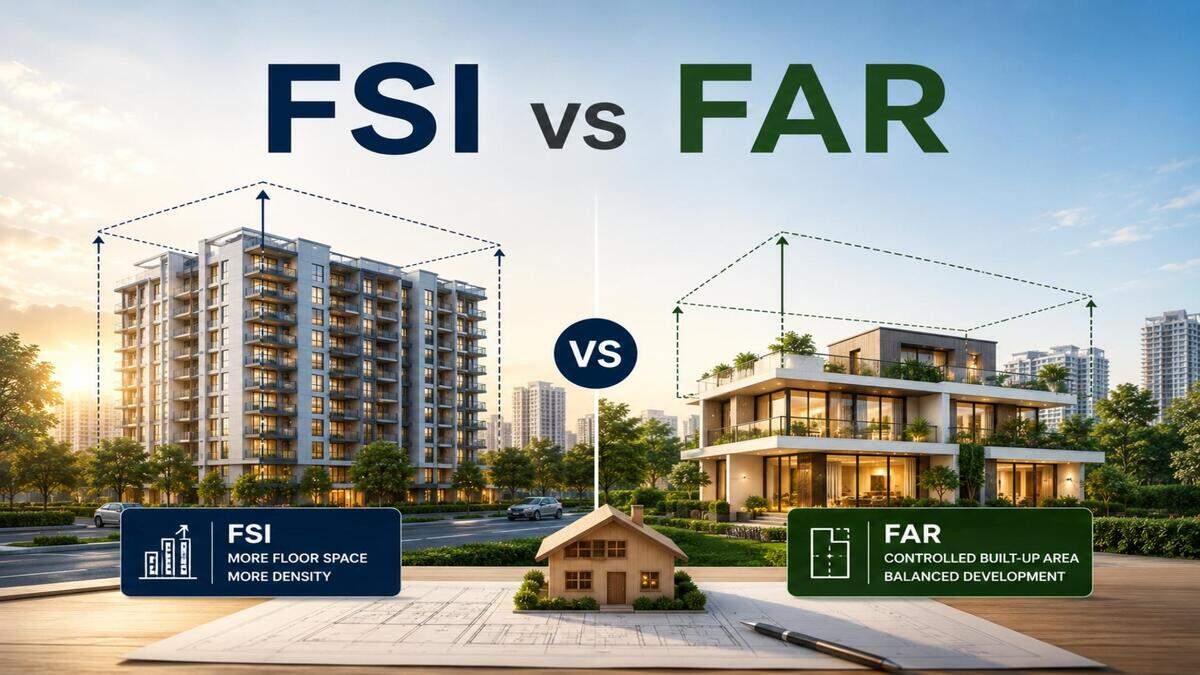
Both terms deal with how much can be built on a plot of land, but they’re not the same thing. In 2025-2026, as cities revise development norms and developers talk about “higher FSI” launches, it helps to know the difference between FSI and FAR and why it matters to you, even if you’re not reading zoning laws.
This guide explains what FSI and FAR are, how they differ, and how to think about them when you’re choosing a project in India.
What is FSI?
FAR stands for Floor Area Ratio, and in many Indian contexts, it is equivalent to FSI: the ratio of total floor area to the plot area.In simple words:
If a plot is 1,000 sqft and the permitted FSI is 2.0, the total built‑up area that can be constructed (over all floors) is 2,000 sq ft.
This includes all floors combined, not just the ground floor.
FSI is set by local development authorities (like Haryana RERA, Noida Authority, DDA, or municipal bodies) and can vary by:
- City or zone (residential, commercial, industrial)
- Road width in front of the plot
- Plot size and development rules in that area
- Parking norms and fire‑safety requirements
- More towers or more floors on the same plot,
- Potentially higher density and less open space if the developer uses the full index.
What is FAR?
FAR stands for Floor Area Ratio, and in many Indian contexts, it means the same as FSI: the ratio of total floor area to plot area.However, the key nuance is:
- FSI is the term commonly used in India and is usually expressed as a percentage (especially in Delhi‑NCR).
- FAR is the American‑style equivalent; internationally, planners and designers prefer FAR.
If a planner in the US talks about FAR 2.0, it’s conceptually the same as FSI 200% in India.
Both are ratios, not absolute numbers.
In practice for an Indian buyer:
When reading a layout plan, RERA brochure, or government notification, you’ll see FSI most often.
When reading global real‑estate or planning articles, you’ll usually see FAR.
At the functional level, FAR and FSI describe the same core idea: how much building you can pack on a given piece of land.
Here’s a simple way to understand FSI vs FAR without getting tangled in technical jargon.In real‑life terms, for a buyer in Delhi, Gurgaon, Noida, or Bengaluru:If a project is built on FSI 2.5 on a large plot, it can mean:However, FSI/FAR only defines the maximum allowed built‑up area; it doesn’t tell you:That’s why, along with FSI, you should also look at:These numbers often tell you more about your actual living experience than FSI alone.FSI and FAR are not just technical jargon in a developer’s pitch deck; they’re real parameters shaping how much gets built on a plot and, indirectly, how dense, spacious, or towering your project will feel.For a buyer:Before you fall for “less congestion, more open space, and higher FSI all at once”, ask:That way, you move from understanding FSI vs FAR in theory to using it in practice when you pick a project in India.If you’re trying to make sense of FSI, FAR, open‑area percentages, and tower‑to‑plot ratios across projects, helps you cut through the jargon. Explore TOI Homes’ curated list of , and choose a project where the FSI fits your lifestyle, not just the developer’s ambitions.
Frequently asked QuestionsFAQs
A FSI or Floor Space Index represents the maximum permissible built-up area allowed on a plot of land, calculated as the ratio of total floor area to the plot area.
Disclaimer: The information presented by TOI Homes, part of The Times of India Group, is for general informational purposes only and does not constitute financial, legal, or investment advice. All data and insights are based on sources believed to be reliable but are not guaranteed for accuracy or completeness and are subject to change due to market conditions. The developer and associated entities are not liable for decisions made based on this information. Real estate investments involve risks, and buyers are advised to conduct independent due diligence and consult certified advisors before investing. TOI Homes does not endorse or promote any specific property or developer unless explicitly stated.