
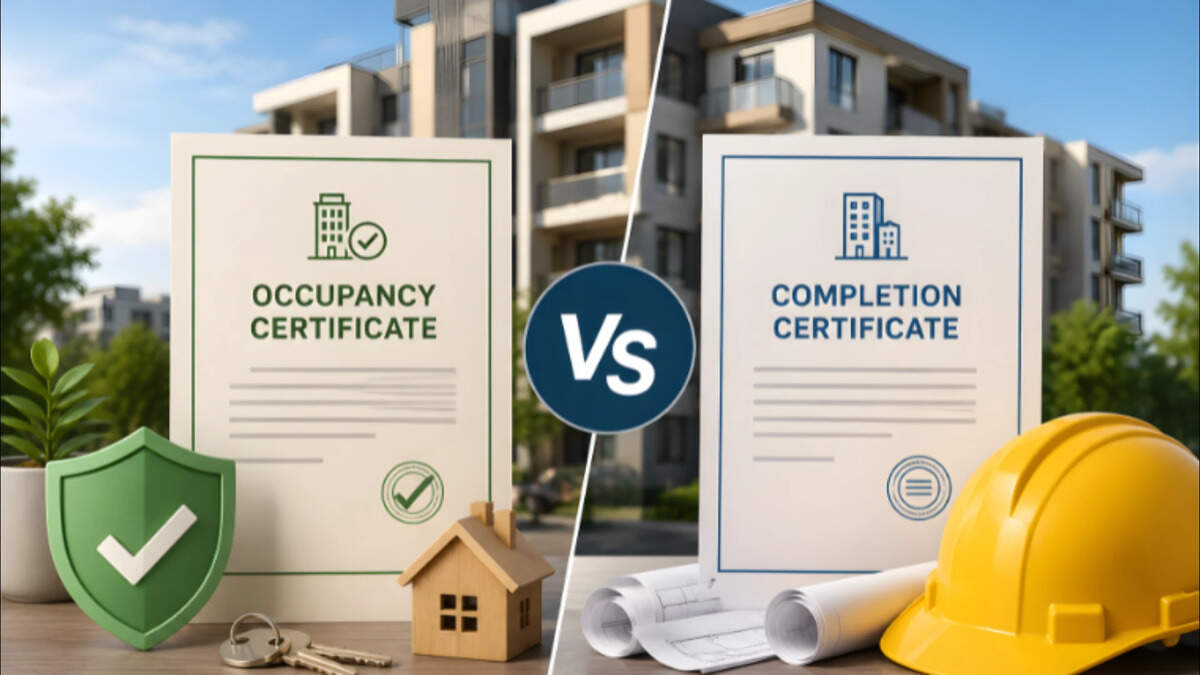
Occupancy Certificate Vs Completion Certificate: Key Differences Every Smart Homebuyer In India Must Know Before Buying
Demystify the critical legal milestones of property buying with our clear comparison of Occupancy Certificates (OC) and Completion Certificates (CC). Understand their distinct roles in confirming construction validity, ensuring structural safety, and securing necessary utility connections. Learn why having both documents is mandatory under RERA to protect your investment, avoid municipal penalties, and ensure smooth future resale transactions.
They may sound similar, but they serve very different purposes. Learning the difference between an occupancy certificate and a completion certificate helps you avoid legal issues, ensure safety, and make a smarter property decision.
What is an Occupancy Certificate?
An Occupancy Certificate (OC) is a legal document issued by local authorities that confirms a building is safe and ready for occupancy. It is granted only after:- Construction is complete
- The building complies with approved plans
- Basic utilities like water, electricity, and drainage are in place
Why is OC Important?
The Occupancy Certificate directly impacts your ownership and living rights. Here are the key reasons why OC matters:- Legal Occupancy: Living in a property without an OC is considered unauthorized
- Utility Connections: Water and electricity connections may be restricted
- Home Loans and Resale: Banks and buyers usually prefer OC-approved properties
- Safety Assurance: An OC confirms that the building meets all the safety standards
Documents Required for Obtaining Occupancy Certificate
The following documents are required to obtain an OC:- Completion Certificate (Issued earlier)
- Approved building plan
- Fire safety clearance
- Structural stability certificate
- NOCs from local authorities
- Proof of utility connections (water, electricity, sewage)
What is a Completion Certificate?
A Completion Certificate (CC) is issued by the local municipal authorities once a building’s construction is completed as per the approved building plan. It confirms that:- The project has been constructed according to legal approvals
- There are no major deviations from sanctioned plans
Why is CC Important?
The completion certificate is also very important. The key reasons why CC matters include:- Proof of legal construction: Confirms the building follows approved plans
- Mandatory for OC: You cannot obtain an Occupancy Certificate without a Completion Certificate
- Avoids penalties: Unauthorized constructions may attract legal action
- Required for property registration in some cases
Documents Required for Obtaining Completion Certificate
In order to obtain a Completion Certificate, developers must submit:Although both documents are crucial, the difference lies in their purpose:Hence, we can conclude that the Completion Certificate comes first. The Occupancy Certificate comes after.Learning the key difference between an Occupancy Certificate and a Completion Certificate is important for every homebuyer. If you are planning to buy a property, make sure both these documents are in place. Skipping this step may lead to legal complications, financial risks, and even issues with basic utilities.At , we go beyond listings to help you make informed real estate decisions. Discover with verified documentation. Plus, get insights into legal approvals, pricing, and investment potential. We simplify your homebuying journey so you can invest with confidence and clarity.Frequently asked QuestionsFAQs
A Completion Certificate confirms construction is done as per approved plans, while an Occupancy Certificate certifies that the building is safe and legally ready for living.
Disclaimer: The information presented by TOI Homes, part of The Times of India Group, is for general informational purposes only and does not constitute financial, legal, or investment advice. All data and insights are based on sources believed to be reliable but are not guaranteed for accuracy or completeness and are subject to change due to market conditions. The developer and associated entities are not liable for decisions made based on this information. Real estate investments involve risks, and buyers are advised to conduct independent due diligence and consult certified advisors before investing. TOI Homes does not endorse or promote any specific property or developer unless explicitly stated.